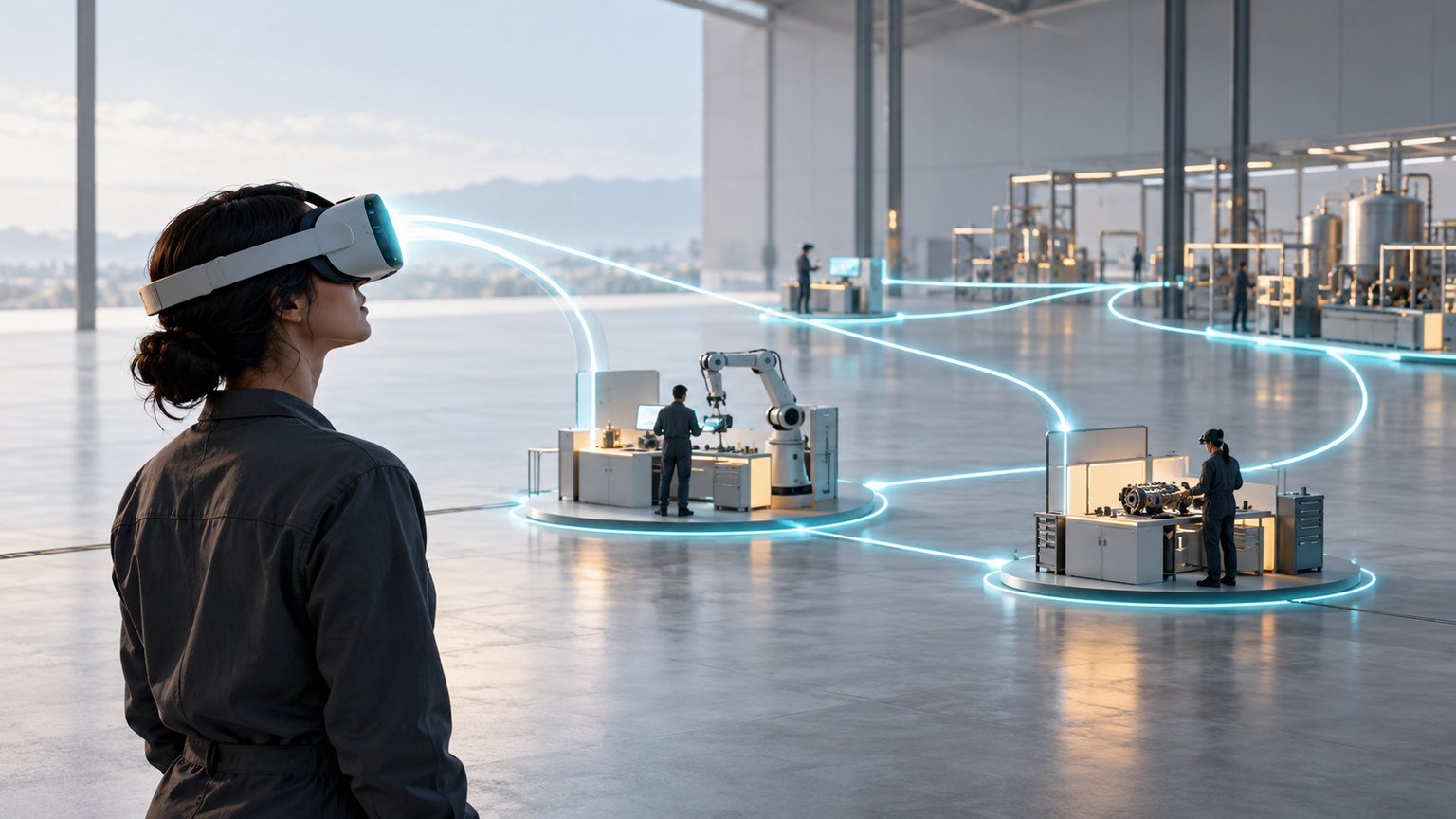
At Little Rock Air Force Base, in Arkansas, one unit trains maintenance technicians without a single aircraft assigned to it. It does so in a virtual hangar built inside a former warehouse, where trainees step into a realistic simulation instead of a real flight line. In its first eighteen months, the programme avoided roughly $18.5 million in training and maintenance costs.
The most interesting detail, however, is not the savings but the reason the programme worked at the first attempt: from the outset, the unit drew on the experience of another unit that had already been through the same journey, and had it pass on the mistakes it had made. What makes the difference, then, is not the technology itself, but the extent to which someone, before starting, planned what would happen once the initial enthusiasm had worn off.
The case described above is not an isolated one, nor does it concern only defence or heavy manufacturing, but it remains an exception, as data from the Politecnico di Milano’s Augmented Reality & Metaverse Observatory confirm: in Italy, for example, more than 600 corporate augmented and virtual reality projects have been launched since 2020 (611 according to the latest survey); globally, by mid-2024 more than 62% of Fortune 500 companies had already launched at least one XR pilot. How many of these then became structured, rolled-out programmes, rather than simply successful but isolated experiments, is a question the data do not answer, but the pattern emerging from industry analyses is the same one observed in the past. McKinsey’s State of AI 2026 report estimates, in fact, that 94% of companies have not yet managed to generate significant economic value from their artificial intelligence initiatives, despite pilots now being extremely widespread, and extended learning is no exception.
Content ages faster than the project
An extended learning module is not a video that, once produced, remains valid indefinitely. It is more like software, requiring continuous maintenance.
At scale, with dozens of scenarios deployed across several plants, content starts to age faster than anyone notices, unless it is treated from the outset as infrastructure to be maintained rather than as a project to be delivered once. That is the logic behind the cloud-based training hub BASF built with AVEVA to train more than 600 operators at its Ludwigshafen site in Germany. With half of its plant operators due to retire within a decade, BASF needed a scalable way to train new recruits, cutting training times by 30-40% compared with traditional classroom teaching. These were not isolated simulations but a centralised system that can be updated without having to rewrite every module from scratch each time a procedure changes.
Roles to be defined: the trainer
The second point of friction concerns people more than processes: in almost every structured organisation there is a figure, the in-house trainer/the expert mentor/the department head, who teaches the trade to new hires and whose role changes, in no trivial way, with the arrival of extended learning.
This plays out, with few variations, in many production departments: the trainer who for years has personally guided every new hire sees the arrival of a headset that, apparently, does the same job. The question they ask is a legitimate one: “if the simulation teaches the procedure, what added value does my role still bring?”.
The companies that manage this transition best do so by explicitly shifting the trainer’s role: from content deliverer to experience supervisor. It is often a more highly skilled role than that of a simple trainer, but it requires dedicated corporate investment that rarely appears in the plans for a pilot project. When this shift is not managed, the trainer becomes the first person not to champion the tool within the company, and that alone is enough for adoption to stall.
The hardware logistics nobody budgets for
It should be said straight away that a headset is not always necessary: in many cases a platform running in a computer or smartphone browser is enough, with no dedicated hardware at all. The hardware logistics problem really arises when the use case calls for genuine immersion.
Five headsets at a single site, with an IT contact looking after them personally, can be managed informally without logistics becoming a visible problem. Scaling up, however, changes the nature of the problem, and quickly. Siemens’ virtual training programme, to take an enterprise example, combines enterprise-grade VR headsets and standalone AR devices at the same time, held together by a single development platform. This is not so much a stylistic choice as a consequence of different scenarios, departments and use cases requiring different hardware, bearing in mind that someone has to ensure they all remain up to date, traceable and working.
In most Italian projects this complexity emerges well before that scale is reached: a few dozen devices spread across several plants are enough for informal management to stop holding up. Dedicated processes are needed for daily charging, for maintaining lenses and straps, for tracking devices and for handling faults, especially at plants without IT support on every shift. None of these problems is conceptually complex, but they are rarely budgeted for in the pilot phase, for the simple reason that they have not yet surfaced at that stage.
And then, who owns the project after the pilot?
This point is probably the most decisive, and concerns a question rarely asked explicitly at the outset: who owns the project once it stops being a mere experiment? In most cases the pilot phase originates in a company’s HR or Learning & Development function, with a dedicated budget and a motivated sponsor: a natural choice, given that this is where the training need arises. Scale, however, requires the involvement of functions that were rarely at work during the pilot: IT, which has to guarantee the infrastructure; the sales team, which has to manage a supplier on an ongoing basis; operations, which have to integrate immersive training into shifts without stopping the lines.
It is the same principle as in the case cited at the start: the Little Rock maintenance unit did not wait to see whether its programme worked before working out who should take it forward. Before installing the first headset, it decided to rely on those who had already gone through the same transition. When governance at scale is designed only after the pilot has been seen to work, it is often already too late: the function that proved the tool works has no mandate to extend it, while the functions that would have that mandate were never involved enough to feel responsible for it.
A design problem, not a persuasion problem
Companies that take extended learning beyond the pilot phase share a common trait: they asked themselves a few critical questions before launching the project, not after seeing the first results. Which indicators will be used to measure whether the pilot has really worked, not just how many people put on the headset, but how much field errors, onboarding time and incident rates have changed? Who will keep the content up to date once the fixed-term project with the supplier has ended? How does the trainers’ role change, and who will train them in turn? Who will manage hardware logistics when devices go from five to five hundred, perhaps of different models? And above all, who will own the project, with budget, mandate and responsibility shared across functions, once it stops being a pilot?
These questions are less immediate, but they remain the ones that determine, more than any cultural change invoked in the abstract, whether an extended learning project becomes a structured programme or simply remains a successful experiment that is never replicated.
More articles

September 2026 · Artificial Intelligence
Humanoid robots: the real capital is the know-how of senior technicians

July 2026 · Education
Techstar brings Education 4.0 to higher technical education

July 2026 · Virtual Reality · Augmented Reality