Milan, 29 July 2026 — The global EdTech market is now worth more than $233 billion and will grow at a CAGR of over 20% through to 2035. In Italy, the digital learning sector already exceeded €3 billion in 2024 (+18% on the previous year), driven by the mass adoption of artificial intelligence and by the training obligation introduced by the European AI Act, in force since 2 February 2025.
ITS Academies are currently the training channel with the best employment outcomes in Italy: according to INDIRE’s 2025 monitoring, 84% of graduates find work within a year, in 93% of cases in a role consistent with their studies. Yet 61% of companies report difficulty in finding qualified technical profiles. It is against this backdrop that the digitalisation of laboratories stops being an option and becomes a strategic priority.
The problem: training the workers of the future with the tools of the present
The client, an ITS Academy in Southern Italy, operates in one of the most challenging local contexts in the country. In Calabria, fewer than 7 in 10 ITS graduates find employment: a figure that captures the structural gap between the training on offer and the local labour market. The institute trains technicians in high value-added fields (from environmental management to biotechnology, from pharmaceuticals to biomedical), sectors in which digital transformation is reshaping profiles and processes rapidly and profoundly.
The challenge was clear: to prepare students to work in complex technical fields, often physically inaccessible, by overcoming the limits of traditional teaching methods. That is why the institute chose Techstar.
Techstar’s solution: Education 4.0 in virtual reality
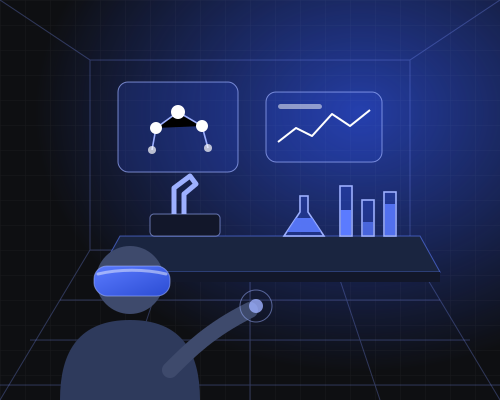
Techstar, an Italian company specialising in XR and Agentic AI with a focus on Education and Operations, has designed a suite of 14 immersive digital laboratories that integrate three core technological components:
- Vertical AI agents trained on the technical vocabulary, regulations and operating protocols specific to each domain, able to guide students in real time
- Interactive virtual environments that allow students to explore complex scenarios, interact with simulated objects and processes and collaborate with other users in real time
- Bespoke 3D models for each laboratory that faithfully reproduce production plants, natural ecosystems and healthcare facilities
The platform is compatible with the devices the institute already owns (PCs, tablets, VR headsets) and can also be accessed via a web browser, by teachers and students alike.
A decisive factor in the choice of Techstar was the platform’s flexibility: each laboratory is custom-designed, with content and scenarios reflecting the specific characteristics of the region and its local production sectors, delivered quickly and in line with the institute’s operational needs.
“The challenge of Education 4.0 is about technology, but also about the ability of an education system to stay connected to a changing world of production. With our client we have built digital environments that simulate and enable learning. Each laboratory is a space for authentic experience, in which students interact with real processes, risks and decisions in complete safety” says Luca Chiabrera, CEO of Techstar. “The integrated artificial intelligence, as well as being a teaching add-on, is what students will find in the workplace, and beyond. This project shows how it is possible to bridge the gap between education and the labour market, even in the most challenging areas of the country”.
The project was funded under Italy’s National Recovery and Resilience Plan (PNRR) in support of ITS Academies, and the laboratories are now fully operational at the institute’s premises, available to teachers and students. Techstar won the project through a competitive open tender, submitting the best proposal in terms of the quality of the solution and the soundness of its design.
More articles
October 2026 · Virtual Reality
Why extended learning projects stall after the demo
September 2026 · Artificial Intelligence
Humanoid robots: the real capital is the know-how of senior technicians

July 2026 · Virtual Reality · Augmented Reality