There are two crises that Italian and European industry are living through in parallel, and they are almost always told separately.
The first is the silent drain of technical skills caused by a generational turnover in factories, construction sites and plants that is often too hasty or poorly aligned. The second is the multi-billion, increasingly crowded race towards humanoid robots capable of working alongside or in place of humans. Those working in industrial innovation tend to treat them as distinct phenomena: on one side a workforce and demographic problem, on the other a matter of the technological frontier. In reality, they are the same crisis seen from two different angles, and the second cannot be solved without tackling the first.
The memory nobody saves
Let us start with the numbers, because on this front Italy has a fairly sharp picture of itself.
According to Excelsior data from Unioncamere and Anpal, the difficulty companies face in recruiting technical profiles rose from 45% in 2023 to 48% in 2024: almost one in two technical hires is hard to complete. This is not a shortage of candidates in absolute terms; it is, above all, a shortage of the specific skills required. The Politecnico di Milano’s HR Innovation Practice Observatory 2024 attributes the mismatch between labour demand and supply chiefly to a lack of technical skills, found in 57% of cases.
Behind these figures, however, lies a demographic dynamic that has now become structural: in 2022, 37% of Italian workers were over 50, compared with 21% in 2005, a doubling in less than two decades that makes it urgent to transfer operational knowledge quickly.
The point, though, is not only quantitative but also qualitative. The literature on skills management in manufacturing estimates that an experienced worker can produce up to 800% more than a new hire on complex tasks, and around 50% more even on low-complexity activities. That differential is made up of micro-decisions and real-time corrections, not of procedures written in a manual: it is the kind of knowledge that no corporate system captures today and that vanishes irretrievably every time an experienced technician retires.
This is not an isolated case: as far back as 2017, to cope with a peak in orders at Porto Marghera, Fincantieri called back a group of retired former employees to work alongside younger workers and pass on technical skills. At the time the decision was contested by the unions, but it clearly signalled how fragile the mechanism for transferring know-how already was when the only channel is people’s memory.
But the phenomenon is not confined to Italy. In the United States, Ford publicly admitted in June 2026 that it had called back more than 350 experienced engineers (the gray beards) after AI-based quality control systems, introduced to replace that generation of expert technicians, had proved inadequate, with an estimated impact running into billions of dollars. Charles Poon, VP Vehicle Hardware Engineering at Ford, commented: “artificial intelligence is only as good as the data it is trained on”. The return of these technicians helped take Ford to first place among mass-market brands in the J.D. Power Initial Quality Study 2026, a result the company had not achieved since 2010.
The other side of the coin: physical robotics’ hunger for data
At the very moment industry is losing this kind of knowledge, another sector has a growing and so far unmet need for it: humanoid robotics and, more broadly, physical AI. The capital flowing into this segment is considerable: in 2024 alone, robotics start-ups attracted around $7.2 billion globally, and Figure AI closed a $675 million round with investors such as Microsoft, OpenAI and Nvidia. These figures and names show how strategic the market considers this technology segment to be.
But there is a growing consensus among those working in the field about where the real bottleneck lies: data.
Teaching a robot to manipulate real objects in unstructured environments requires an enormous volume of high-quality physical demonstrations: sequences of movement, force and real-time corrections, collected from people who know how to perform these actions well and can adapt intuitively to any working condition. It is knowledge handed down through imitation and direct experience, not by reading a manual: no theoretical document explains how you “feel” a weld that is not going as it should. It is precisely this “unwritable” knowledge that is missing today from the datasets used to train robots.
That is why many of the humanoid robot “deployments” presented to the public are in fact teleoperation set-ups: a human operator controls the robot remotely, while the system records the data that will be used tomorrow for autonomous training. That is the state of the art, and it is worth knowing.
Where the two crises meet
Here is the detail still missing from the public debate on these issues: the tacit knowledge that Italian industry risks losing forever because of a hasty and often misaligned generational turnover is exactly the kind of data that physical robotics desperately needs to move beyond the experimental phase.
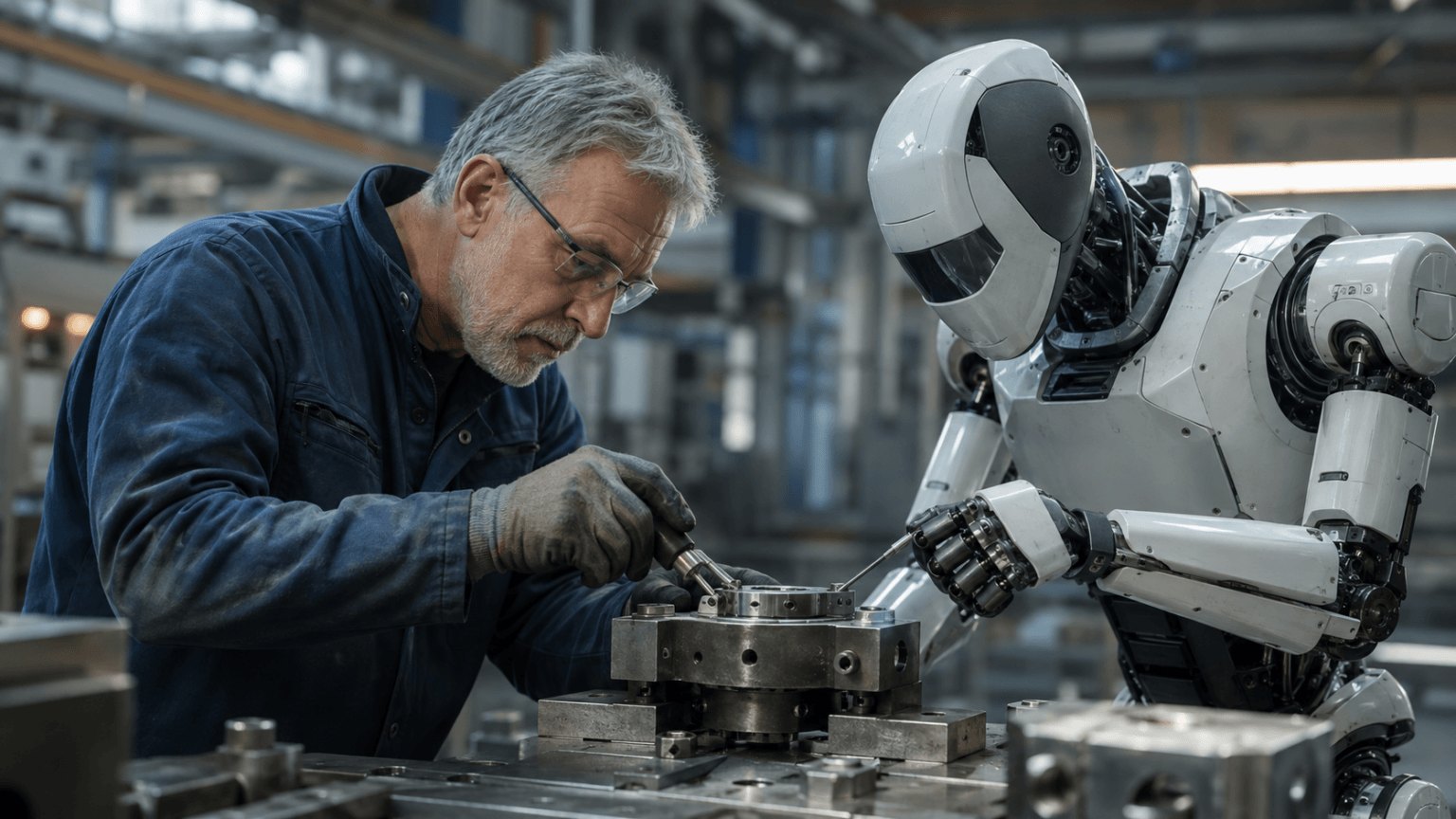
This is not just an unfortunate coincidence of timing: it is the same resource, seen from two perspectives. The action of a technician who recognises an anomaly from a sound, or who adapts a procedure to conditions no manual anticipates, can, if recorded, train an imitation learning or behaviour cloning system that reproduces it.
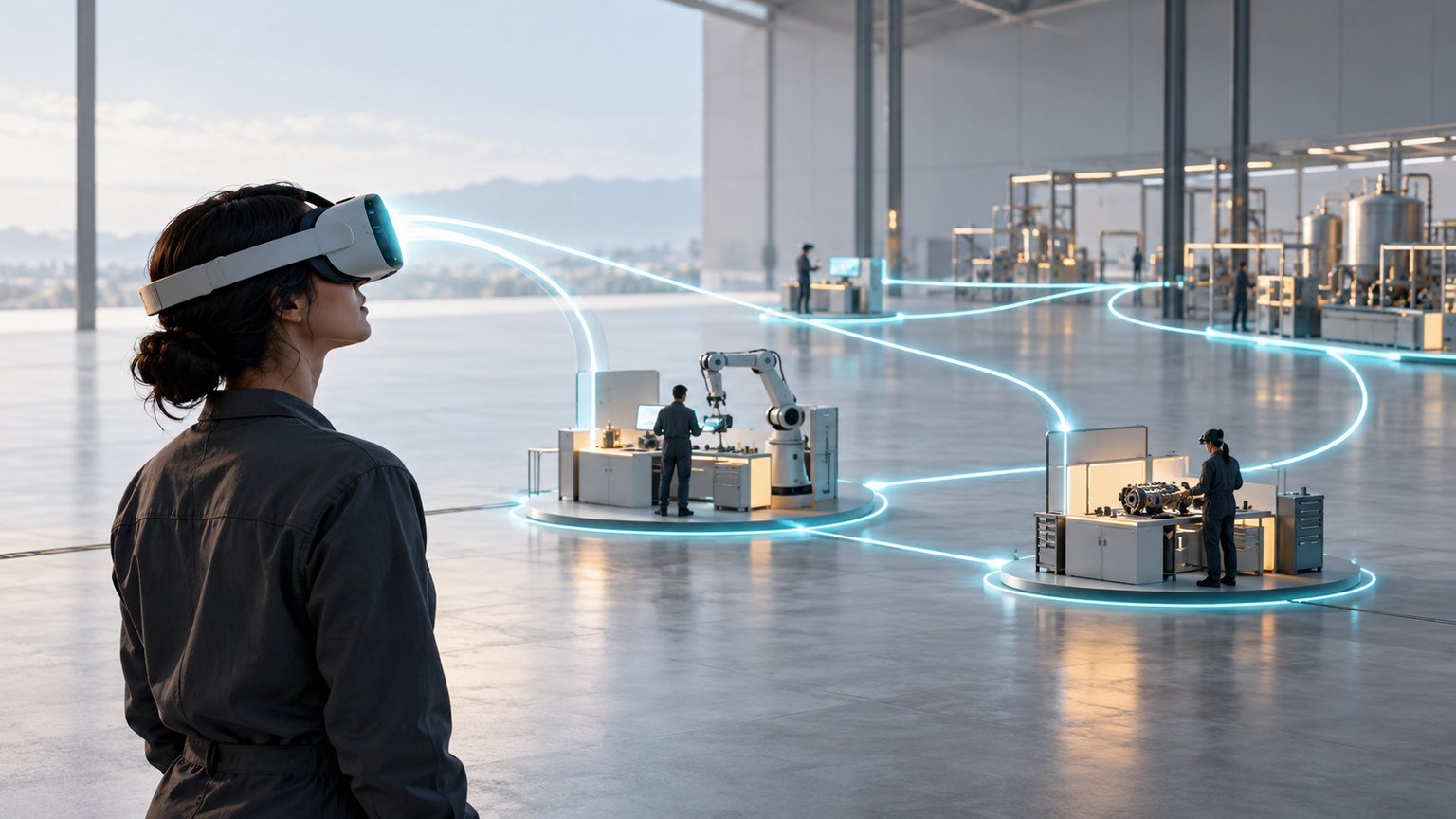
This changes the question companies should be asking: not only how to retain the knowledge of their senior staff, but how to build the infrastructure that turns every field intervention into an asset that accumulates over time, useful first as operational support and then as a basis for training physical robotics.
Italy: the asset that already exists and goes unrecognised
The debate on humanoid robots is currently dominated by American and Chinese players, by promises of large-scale production and by valuations that observers are beginning to view with caution: it is a legitimate debate, but it risks making the topic seem relevant only to those with enormous capital to invest in hardware.
There is, however, another path, less often talked about: that of those who possess, in a specific industrial sector, decades of operational know-how that has never been digitised, an asset that cannot be bought with a funding round but is built over decades of work in the field. And Italy, with its high value-added manufacturing industry and its excellence across a range of product sectors, has it in abundance. The question to ask is whether we are losing it faster than we can record it.
Those who start building this infrastructure today, even in its simplest form, that of remote assistance and structured documentation of operations, are building, action by action, the data heritage that will decide who, a few years from now, has the best-trained robots: in other words, who has managed to turn the experience of the best technicians into something that no longer disappears.