
We have spent five years arguing about where to work: office or home, fully remote or hybrid, mandatory return or total autonomy. The debate has consumed enormous energy, producing often contradictory company policies and fuelling a silent war between control-minded managers and trust-minded workers. Meanwhile, the question we should have been asking was not so much about where, but about the very idea of presence.
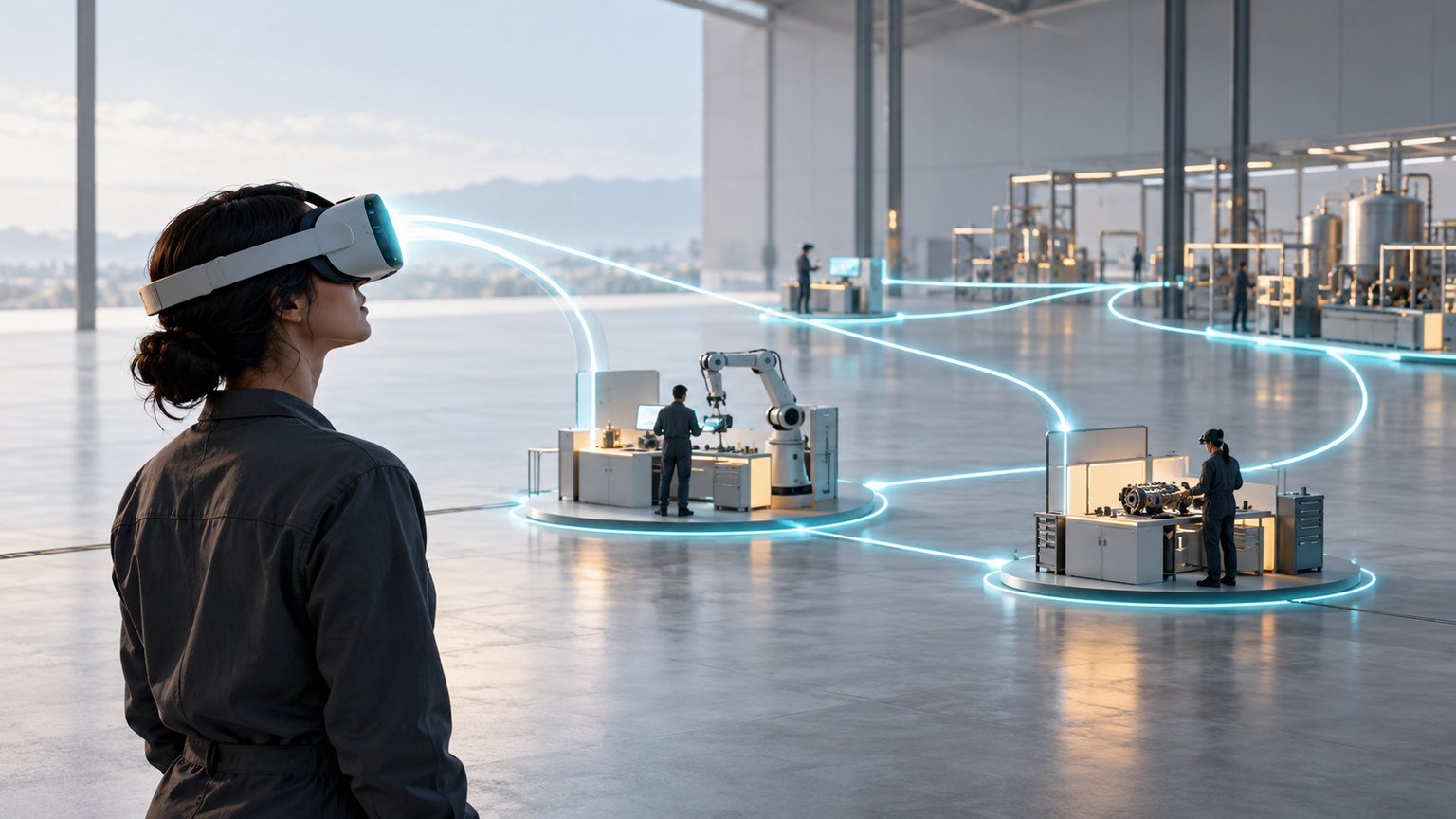
And the answer to that question may be spatial computing: which is not a more sophisticated headset or the enterprise version of a video-game gadget. It is a paradigm shift in the nature of the workplace, where the boundary between physical and digital does not disappear, it simply becomes irrelevant. An employee can be sitting in Milan and physically collaborating with a colleague in Berlin, in the same space and in real time. This is not merely a shared screen, but genuinely the same space.
This is the change we are seeing on the horizon and which, to a large extent, is already here. But are we really ready?
Enterprise spatial computing in numbers
The reports already describe an evolution rather than a future promise. The global spatial computing market reached around $180 billion in 2025, and projections take it to over $418 billion by 2029. According to SNS Insider data, the enterprise share, which covers training, design, remote collaboration and manufacturing, already accounted for 58% of the total in 2025. These figures show that it is not gaming that is driving the market and its growth, but businesses.
There are unmistakable strategic signals confirming all this: in 2025, Microsoft integrated Mesh functionality directly into Teams and Azure services, enabling shared holographic environments across different devices for enterprise users. Similarly, Google launched Android XR, a mixed reality platform with built-in generative artificial intelligence. Apple, too, did not target the average consumer with Vision Pro: it sent a clear signal straight to business leaders around the world.
Ford, BMW, Accenture and Boeing have also already made the leap without going through an experimental phase: they simply decided to bet on a work infrastructure that today is, to all intents and purposes, operational and functioning.
Italy, Europe, the world: who leads and who follows
The global picture is fairly unforgiving, but looking at it is the only way to change it.
The worldwide enterprise spatial computing market is dominated (once again) by North America, which closed 2025 with 42% of total revenues, boasting an ecosystem of more than 180,000 active XR developers and adoption that has already moved from pilots to large-scale enterprise implementations.
The Pacific nations, such as South Korea, Japan and China, are part of the fastest-growing region, with projected CAGRs above 26% through 2034, supported by massive public investment in vocational training and 5G infrastructure.
Europe sits in the middle: a market of around $31 billion in 2025. Within this picture, Germany remains the largest market on the continent, while the United Kingdom is the fastest-growing, thanks in part to a particularly vibrant XR start-up ecosystem. Denmark and the Netherlands, according to the SME Digital Growth Index 2025, lead in SME digital maturity, with digitalisation indices of 66% and 60% respectively.
Finally, Italy. It ranks 45th in the world for AI adoption in business (last among the five largest European economies, more than ten percentage points behind France and Germany). According to Politecnico di Milano’s Osservatorio Innovazione Digitale nelle PMI 2025, the picture is even starker: only 19% of Italian small and medium-sized enterprises adopt advanced technologies in a structured way. And the most revealing figure is that 91% of Italian SMEs have not yet spent, and do not plan to spend, on augmented reality, virtual reality or immersive technologies. This places the vast majority of Italy’s productive fabric outside the spatial computing conversation at precisely the moment it becomes strategically relevant.
And here lies the Italian paradox: we are among the countries with the highest 5G coverage in Europe (99% versus a European average of 94%), we have a network infrastructure that is up to the task, but we lack the will to use it for anything more than a simple Zoom meeting.
The cultural sticking point for spatial computing in Italy
In Italy, the problem with spatial computing is managerial and cultural, and it would be wrong not to point this out.
Presenteeism is still the implicit metric used by many Italian companies: in 2025, 95% of large Italian enterprises had implemented structured smart working initiatives, but among SMEs the figure stops at 45% (down 8% on 2024). These numbers bring to light a problem of cultural regression: trust has not yet replaced visual supervision as a performance metric.
In this context, spatial computing risks being perceived as a luxury, something only large corporations can afford. But this is simply a misreading, because the real promise of spatial computing for mid-sized companies is to cut travel costs, train technical staff better without halting production, and collaborate with customers and suppliers in a way that is richer than a video call and less costly than being there in person. These are real problems that already have solutions available, in a market where the cost of hardware has fallen significantly over the last 24 months.
But the turning point lies in the latest generation of headsets and smart glasses. They weigh less than 250 grams, about as much as a pair of sunglasses, and can render digital text as sharply as print. The technical barrier, then, has come down, unlike the narrative one: there is a lack of clearly told Italian success stories, a lack of a management class that has experienced these technologies first-hand, and a lack of awareness that the gap widens with every quarter spent waiting.
From hybrid work to shared cognitive space
We gave a good answer, but to the wrong question
The debate of the last five years ignored the most important thing: it stopped at the surface, “where are you physically?”, “are you in the office or at home?”. With spatial computing these questions lose their meaning, or at least their centrality. The new question to ask is “who do you share cognitive and operational space with, regardless of where you are physically?”.
According to the World Economic Forum, augmented and virtual reality are identified as one of the key factors for skills development in high-growth sectors over the next decade. And 2026, according to GlobalData forecasts, will mark a significant acceleration in the adoption of enterprise spatial computing, with industries moving from pilot implementations to operational deployments at scale. The point of no return, where those who have not invested find themselves structurally behind those who have, is approaching faster than most Italian decision makers are considering.
So this is not about chasing a trend: it is about deciding whether to take part in redefining what working together means, or to discover, a few years from now, that the answer has already been written by others.
The workplace of the future has a digital latitude, and those who start building it today are doing so in order not to have to race to catch up later, not simply to keep pace with the times.
More articles
October 2026 · Virtual Reality
Why extended learning projects stall after the demo

September 2026 · Artificial Intelligence
Humanoid robots: the real capital is the know-how of senior technicians

July 2026 · Education