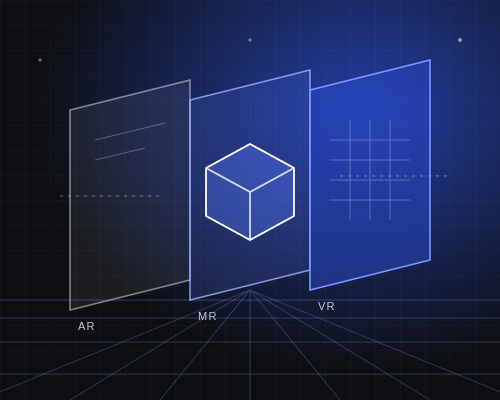
Milan, 13 April 2026 — Despite the maturity that extended reality has reached – the umbrella term for virtual reality (VR), augmented reality (AR) and mixed reality (MR) – the debate around these technologies is still shaped by a set of misconceptions that are slowing their adoption in business. Distorted perceptions, fuelled by disappointed speculative expectations and often superficial media coverage, have bred a widespread scepticism that weighs particularly heavily on Italian companies, which already lag behind Europe’s leading markets in the digital transition.
Techstar, an Italian company operating at the intersection of XR and AI, has identified the 5 most persistent myths and explains why the time has come to move beyond them.
Myth 1The decline of the metaverse spelt the end of XR
The fading of speculative expectations around the consumer metaverse has not affected — nor could it have — the trajectory of extended reality as an operational technology. Equating an overhyped media phenomenon with an entire technology category is an error of perspective that has had real consequences for many companies’ investment decisions, and one that technology history has seen before.
Gartner’s Hype Cycle model offers a precise lens: XR has passed through the peak of inflated expectations, slid into the trough of disillusionment and now sits on the slope of enlightenment, the phase in which a technology stops making promises and starts delivering proof. It is the same path the internet followed after the dot-com crash of the early 2000s: at the time, many wrote off the commercial web, only to witness the rise of Amazon, Google and a trillion-dollar digital economy. Those who left the market at that point missed out on its most profitable phase.
The data tell a similar story for extended reality: according to IDC, the global AR/VR market exceeded $50 billion in 2024, with double-digit growth projected over the following five years. Organisations that have adopted XR as an operational tool in manufacturing, healthcare, energy and professional training have not changed course. On the contrary, they are consolidating their investment on the strength of documented results in efficiency, error reduction and process optimisation.
Separating speculation from industrial application is the first step towards a clear-eyed strategic assessment of this technology — and towards avoiding the mistake of those who, twenty years ago, confused the end of a bubble with the end of an era.
Myth 2XR is only accessible to large companies
The evolution of hardware, with the rise of new-generation standalone devices, and the availability of scalable platforms have profoundly reshaped the economics of an XR project. Launching a concrete pilot no longer requires dedicated infrastructure or six-figure investment.
Techstar supports organisations through gradual adoption pathways, calibrated to real operational needs and defined return-on-investment horizons. From specialist technical training to assisted maintenance, the company has shown how advanced extended reality solutions can be implemented with methodological rigour well beyond large corporates, generating measurable impact on business performance in the short term.
XR is not a privilege reserved for organisations with unlimited budgets. It is a mature, scalable technology and, when properly implemented, accessible to any company that wants to move ahead of the market.
Myth 3XR cannot be measured: its return is impossible to assess
Among the most tangible barriers to business adoption — often unstated, but present in the objections of CFOs and investment committees — is the belief that the impact of XR is hard to quantify and therefore hard to defend when budgets are allocated.
It is a myth that deserves to be addressed precisely. Well-structured extended reality projects are measured through clear indicators: shorter onboarding times, lower costs from operational errors, fewer hours of machine downtime, higher retention rates in training, and less travel for supervision and maintenance activities. Techstar builds an impact measurement framework into the design phase from the outset, enabling organisations to monitor results and fine-tune investment over time.
XR is no less measurable than any other investment in operational technology. Like all of them, it requires a methodology, not an absence of expectations.
Myth 4Extended reality and artificial intelligence are separate technologies
Treating XR and AI as distinct, parallel fields is today one of the most limiting misunderstandings for anyone working in business innovation. Convergence between the two technologies is not a future trend: it is already under way and is producing solutions that are qualitatively different from what either discipline can deliver on its own. Artificial intelligence applied to extended reality makes it possible to create adaptive immersive environments, simulations that evolve in response to user behaviour, contextual virtual assistants built into the experience and systems for real-time performance analysis during training or operational sessions. Techstar works precisely on this frontier: its distinctive strength lies in the native integration of XR and AI, which enables it to design solutions that are smarter, more customisable and have a longer technology life cycle than traditional XR applications. Anyone assessing extended reality without considering the AI multiplier is analysing a technology that no longer exists in its current form.
Myth 5Extended reality isolates people: it is incompatible with a collaborative culture
The image of the XR user as someone cut off from their surroundings is deeply rooted in the popular imagination, but it does not reflect the patterns of use that characterise enterprise adoption. New-generation collaborative platforms allow teams spread across multiple regions to work in shared environments, interact with three-dimensional models in real time and run joint operational sessions with a level of presence that traditional videoconferencing is structurally unable to replicate.
In a business context shaped by hybrid organisations and international teams, this is not a detail: it is a tangible operational advantage. Techstar develops immersive collaboration solutions designed to integrate into existing workflows, with the aim of reducing the perceived distance between people, functions and sites, and raising the quality of remote professional exchanges.
Extended reality does not erode the relational dimension of work; it transforms it and, in many contexts, significantly enhances it.
For Italy’s productive system — historically excellent at execution, less responsive in adopting emerging technology paradigms — the persistence of these myths has a direct impact on competitiveness. In sectors such as advanced manufacturing, energy, industrial design and training, XR is no longer a bet on the future but a tool already in use by leading international players.
Techstar positions itself as a strategic partner for organisations that intend to approach this transition with method, expertise and a long-term vision, through XR solutions integrated with artificial intelligence and, in academic education, through Techstar Education.
“Every technology cycle goes through a phase of disillusionment. For extended reality that phase is over, and what remains is a solid, measurable technology that is increasingly integrated with artificial intelligence”, says Luca Chiabrera, CEO of Techstar. “Today the problem is cultural: in Italy we are still debating whether to adopt XR, while elsewhere people are already working on the second generation of applications. Companies that choose to invest now are not getting ahead of the future; they are closing the gap with markets that moved earlier. Our job is to make this transition concrete, measurable and sustainable”.
More articles
October 2026 · Virtual Reality
Why extended learning projects stall after the demo
September 2026 · Artificial Intelligence
Humanoid robots: the real capital is the know-how of senior technicians
July 2026 · Education