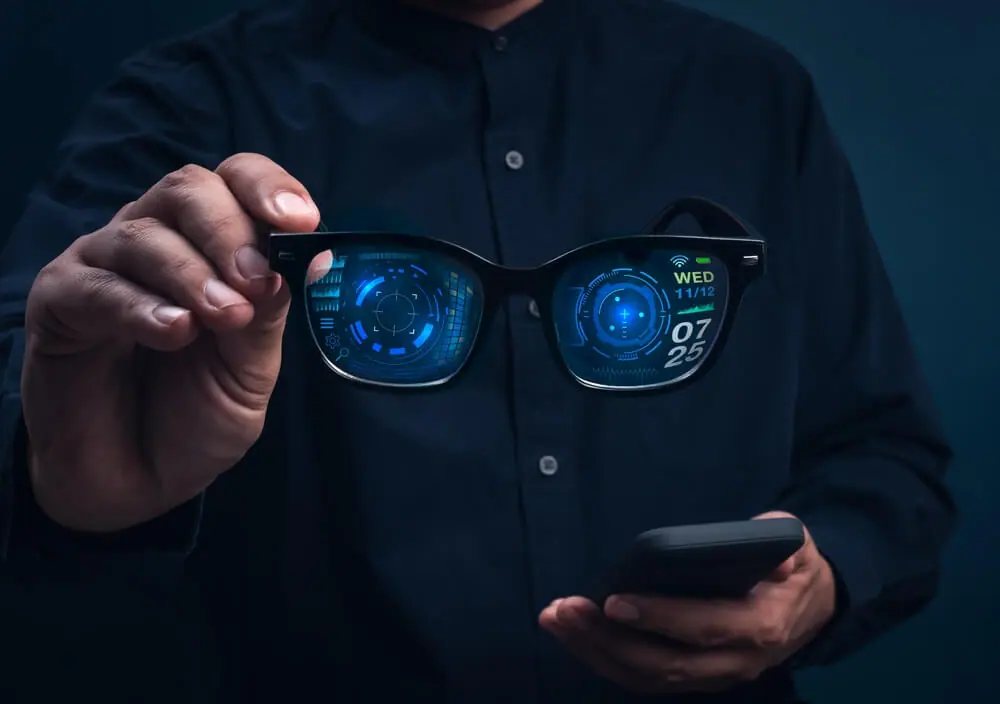
For years, whenever smart glasses came up, minds inevitably turned to virtual reality headsets: bulky, expensive devices designed for niche immersive experiences. Yet something is changing substantially. Today we are witnessing a convergence of factors (hardware miniaturisation, AI maturity, new interaction paradigms) that is reshaping the entire smart glasses category. This is no longer a futuristic promise, but a market taking shape, with concrete implications for businesses and for the way we work.
From headset to glasses: a paradigm shift
The distinction is not merely aesthetic: traditional headsets introduce a physical barrier, isolating the user from the real world and the people around them. New-generation smart glasses follow the opposite logic: they integrate into reality, enrich it and enhance it. They are therefore designed to be worn for hours, not for limited sessions of use. This paradigm shift opens up radically different scenarios, especially in the enterprise space.
In industry, a technician working on a complex plant can receive instructions overlaid on their field of view, consult diagrams and procedures entirely independently, and contact a remote expert hands-free. In medicine, a surgeon can access patient data without looking away. But smart glasses can be used in virtually every sector, from logistics to retail and professional training: vertical applications are already operational in many contexts, often with measurable results in terms of reduced errors and execution times.
The market and the players
Market consolidation is under way. Meta, with Ray-Ban Meta, has shown that it is possible to combine acceptable design and advanced functionality (from a built-in AI assistant to content capture) at a price accessible to the general public. Apple, with Vision Pro, deliberately chose a premium positioning in order to build the ecosystem before moving down-market, while companies such as Snap, Google, Samsung and several Asian players are occupying intermediate positions.
What emerges clearly is that no player has yet set the standard. The market is open, and this is a significant window of opportunity both for those developing vertical solutions and for companies wishing to position themselves as early adopters in specific sectors.
The critical threshold: affordability, availability, usability
The real question is not whether the technology works, but whether and when it will reach a critical mass of adoption. And three variables determine that threshold.
The first is affordability: hardware costs need to fall to a range compatible with standard corporate budgets, without requiring extraordinary justification when investments are approved.
The second is infrastructural availability: high-performance smart glasses require low-latency connectivity, edge computing capability and integration with existing management systems. The technology exists, but it requires architectural work that is not always within the reach of small and medium-sized businesses.
The third point, often the most underestimated, is real-world usability: a device that requires significant behavioural adaptation, that causes fatigue or creates friction in daily use will not be adopted. Ergonomics and UX are just as decisive as the technology.
The geographical divide: where Europe is lagging
Market data paint a clear picture, and for Europe it is not entirely reassuring. North America holds around 36-40% of the global smart glasses market, with the United States alone accounting for over 31% of total value: a leadership position built on the concentration of big tech players, R&D investment and a venture capital ecosystem that injected more than $2 billion into AR/AI wearable start-ups between 2023 and 2025. Asia-Pacific, while starting from a smaller share (around 22-30% depending on the source), is growing faster, with projected CAGRs of around 27% through 2033, driven by China, Japan and South Korea, which combine manufacturing capacity, widespread 5G infrastructure and massive industrial adoption.
Europe stands at around 19-20% of the global market, a far from negligible share, but structurally behind on enterprise adoption. Germany is the most significant exception: the automotive sector (BMW, Mercedes-Benz and Volkswagen) has already launched large-scale AR deployments on assembly lines, with visual guidance and quality inspection applications. Companies such as Siemens, Deutsche Telekom and Honeywell have announced extensive implementations, reporting measurable ROI within 12-18 months and error-rate reductions of up to 40%. France, with players such as AMA XpertEye, has developed specific solutions for remote assistance and training in regulated environments.
In this landscape, Italy suffers from a double delay: the structural one in industrial digitalisation (well documented by the European Commission’s DESI indices) and the more specific one in the adoption of wearable technologies in manufacturing. And yet the Italian production landscape, made up of SMEs with complex processes, highly specialised craftsmanship and a strong reliance on human know-how, is in theory particularly fertile ground for smart glasses: these are exactly the contexts in which transferring skills, guiding operators and reducing errors generates the most value. The gap is not technological, but cultural and organisational, and that makes it bridgeable, provided work on it starts now.
A new generation of spatial computing
If the three variables mentioned above converge (and current trajectories suggest that this is the direction, even if the timing remains uncertain), the market will witness the birth of a new generation of spatial computing. Not the virtual reality of the 1990s, not the Google Glass of 2013, not headsets for gamers, but something structurally different: a computational layer overlaid on the physical world, continuously and naturally accessible, integrated into real workflows.
For technology companies this means one specific thing: those who start today to build skills, experiment with use cases and forge the first partnerships with hardware manufacturers will have a real advantage when the mass market opens up. This is not about following a fad, but about recognising a technological discontinuity while it is still taking shape and positioning oneself accordingly.
More articles
October 2026 · Virtual Reality
Why extended learning projects stall after the demo
September 2026 · Artificial Intelligence
Humanoid robots: the real capital is the know-how of senior technicians

July 2026 · Education